Thursday, April 16, 2009

Bart Interrupted--- A detailed Analysis of 'Jesus Interrupted' Part Five


In chapter five of his book, Bart Ehrman sketches out a basic narrative of the historical process which led to the production of the Gospels. I do not really disagree much with him about either the dating of the Gospels, or the Synoptic problem (i.e. the relationship of Matthew, Mark and Luke), but where I would have serious disagreements is with his analysis of the historical process that led to the production of the Gospels. In essence the difference is this—he imagines a long chain of oral tradition, involving the telling of these narratives by many people who were not eyewitnesses, which eventually led to the writing down of these traditions by others who were neither eyewitnesses nor in touch with eyewitnesses. By this means he seeks to explain what he sees as the many discrepancies in the Gospels. Besides the fact that this analysis is based on some enormous unproven assumptions, it in fact goes flatly against both the internal and external evidence we have about the matter. Let me illustrate, starting with Lk. 1.1-4.

In Lk. 1.1-4, Luke tells us that he had observed, for a long time the “things which have happened amongst us” and more crucially he says that many had compiled a written account of things before he did. In addition, and most crucially he adds that he had consulted eyewitnesses and the original preachers of the Gospel message. On the prima facie showing of this preface to his Gospel what would it be reasonable to deduce about the gap between Luke and the original Gospel events? Was he writing at a time or a place so far removed from the original events that he could not consult those who were actually eyewitnesses of these things? Unless one wants to claim Luke is simply telling a lie, which few scholars would do, Luke is telling us that while he himself is not an eyewitness of the life of Jesus, nevertheless he knew and had consulted those who were, and used them as sources in his work. We must also conclude that he had written sources, which he calls ‘many’. I suspect he means Mark, perhaps a written collection of Jesus’ sayings (‘Q’), and perhaps Matthew as well, and there may have been other sources as well. Now it is the consensus of most scholars that Luke is the latest of the Synoptic writers, using Mark, and possibly knowing Matthew as well, but in any case later than Matthew. He probably wrote sometime in the 70s, or possibly even the 80s. This reminds us of an important point. There were still eyewitnesses around to be consulted until the very end of the first century, as Papias tells us, for he consulted a couple of them in the early second century.

Now if Luke indeed consulted eyewitnesses and written sources, then the myth of a long chain of oral tradition with many weak links cannot stand close scrutiny. But there is in addition external evidence as well on this matter from a reliable tradition in Papias. It says the following:

"And the presbyter said this. Mark having become the interpreter of Peter, wrote down accurately whatsoever he [i.e. Peter] remembered. It was not, however, in exact order that he related the sayings or deeds of Christ. For he [Mark] neither heard the Lord nor accompanied Him. But afterwards, as I said, he accompanied Peter, and formed his [Peter’s] instructions into chreiae, but with no intention of giving a complete narrative of the Lord's sayings. Wherefore Mark made no mistake in thus writing some things as he remembered them. For of one thing he took especial care, not to omit anything he had heard, and not to put anything fictitious into the statements."
Now the presbyter in this statement is the man Papias calls John the elder. This is not John Zebedee, whom Papias had not met, but rather John of Patmos, who himself had been in touch with the earlier eyewitnesses, including the Beloved Disciple. If you want this statement by Papias properly unpacked at length, read Richard Bauckham’s excellent treatment of it in Jesus and the Eyewitnesses, and if you want a lengthy critique of Ehrman’s myth about long and weak chains of oral tradition see my critique of James Dunn’s Jesus Remembered, forthcoming in my What’s in a Word?. Here it must be sufficient to say that Mark was the interpreter and translator of Peter. What the Greek text of this passage suggests is that Peter often spoke in Aramaic, and Mark translated for him, and this included translating various stories about Jesus and his words and deeds into Greek. This explains a good deal about the Gospel of Mark (not least its various parenthetical translations of Aramaic words). Jesus spoke in Aramaic and so did Peter. Mark was more skilled in Greek than Peter.

Now Papias tells us that Mark had no intention to give a full or completely chronological account of the life of Jesus, but simply to present some of the salient memoirs of Peter. He also tells us that Mark formed these narratives into chreiae, the rhetorical form for a persuasive short story that normally ended with a bang with either a notable saying of the hero, or a notable action of the hero. What this tradition tells us of course is that there is no long oral tradition gap between the events in the life of Jesus and Mark’s Gospel--- Peter himself is the missing link. And here it is worth adding that it is highly unlikely that the second century church, so enamoured with apostolic and eyewitness testimony, would have made up the notion that two of our earliest Gospels were written by non-apostles and non-eyewitnesses like Mark and Luke, who on the very showing of the NT itself were minor figures in early Christianity, not major ones. To this of course we could add the testimony about the Fourth Gospel from John 21 which says explicitly that the Beloved Disciple was an eyewitness of some of the events in Jesus’ life, that he wrote down his own memoirs, and that later the community collected them and composed what we call John’s Gospel. I would suggest the reason it is called that is because it was in fact John of Patmos who, having returned to Ephesus from exile, was the one who collected and edited the Beloved Disciple’s material. This is the same John who wrote Revelation and whom Papias had met.

There are other points in Chapter Five that need to be challenged: 1) the notion that Paul tells us nothing about Jesus or his words and deeds. In fact every Pauline scholar I know would say this is false. Not only because he can recite the tradition passed down to him about the last supper (1 Cor., 11), or the death, burial and resurrection of Jesus (1 Cor 15), but also because with some regularity he draws on the teaching of Jesus (see 1 Cor. 7, and Rom. 12 and Gal. 6 for example). Furthermore, in his earliest letter, Galatians, Paul tells us he went to Jerusalem more than once and consulted the three pillars of the Jerusalem church James, John, and Peter (Gal. 1-2). You may be sure that the subject of the many conversations included Jesus and his words and deeds. 2) Amazingly, Bart Ehrman serves up warmed over Albert Schweitzer and his largely discredited theories about Jesus, from over a century ago, not only in Bart’s own book on Jesus as an apocalyptic prophet, but again here in this book. Schweizter to his credit was right that Jesus’ message and mindset was eschatological and prophetic, but he was quite wrong that Jesus thought the world was definitely ending in his lifetime and completely wrong that Jesus predicted the world would end within a generation. We have already dealt with this in a previous post (see e.g. Mk. 13.32). The fact that Ehrman ignores the numerous critiques of Schweitzer’s theories in most other recent detailed scholarly works on Jesus (see e.g. Wright’s Jesus and the Victory of God, or Flusser’s Jesus as Sage, or my Jesus the Sage, and Jesus the Seer, or John Meir’s massive multi-volumes on Jesus a Marginal Jew, or A.J. Levine’s A Misunderstood Jew and there are many more), is frankly just not responsible scholarship. Of course the masses who read Ehrman’s book don’t realize that most Jesus scholars would disagree with him about this, because of course their works have not appeared in such popular form as this easy to read book. 3) on p. 174 we come to a statement which explains much, historians are unable to discuss miracles. He says this because he believes “there cannot be historical evidence for a miracle” (p. 175). This of course depends on what counts as evidence. I do not frankly see the evidence for ancient or modern miracles as any different than the evidence for other sorts of events. We should use the same criteria to evaluate all historical claims--- multiple attestation by reliable witnesses, and the like, which criteria Bart lists. A miracle, like any other historical event is a unique event. It does not differ from other historical events in this respect. This is of course why any historical event differs from a repeatable laboratory chemical experiment.

And this brings me to the issue of the study of history as opposed to the study of nature. The form is largely an analytical art, the latter is a science which involves empirical experimentation. It is a mistake to see the study of any ancient historical event as a “science”. It isn’t because historical events are by definition unrepeatable one time occurrences. It is equally a mistake, and this is where Bart’s definition of a historian goes sadly awry, to assume either that: 1) we know all the laws of nature, or 2) that they cannot be accelerated or transcended by the God of nature. At a minimum, even a skeptical historian must allow that remarkable and inexplicable things do happen in history, things not explicable by modern science. This is no knock on science, but like any discipline of knowledge it has its limitations. Just as I would not use my wife’s knowledge of botany to study Napoleon, so we should not apply the rules for chemical experiments or scientific testing of nature to study any historical event. Historians of course do seek to establish what probably happened in the past, and since miracles by the millions have been reported in all ages of history including the current one, it is quite impossible to say that miracles are the least probable historical occurrences. How in the world could we know that? Has anyone assessed all the occurrences of everything in all of human history and then weighed the probabilities? Certainly not. No one has that sort of exhaustive knowledge, and no historian should be so presumptious as to assume that he knows miracles have always been improbable. Rather, in humility, he should be open to whatever is the most plausible historical explanation of this, that or the other event, and then in addition admit, that sometimes we have to say ‘I don’t know or can’t explain that. Maybe it really happened and really was a miracle.’

Me personally, I am not merely open minded about this, I have been present when miracles of healing happened, that the doctors were unable to explain. This doesn’t mean it didn’t happen or a good historian should just ignore this kind of event in someone’s life, though he may be led to say ‘I don’t know how that happened, it doesn’t seem explicable in purely naturalistic terms’. But then there is no law that requires a good critical historian to be a naturalist in his assumptions about all life. None whatsoever. Let me leave you with a true story.

Some time ago I was pastoring in Coleridge N.C. and had gone to Charlotte with my wife for a few days to visit my folks. One of our most stalwart church members, Bertha Albright, suddenly and unexpectedly became ill on a Saturday and was dead by the time we returned. This was in an age before cell phones, and when I arrived back in Coleridge my neighbor was frantic and asking me to come to his house. He was worried his mother had gone bonkers. You see, Mrs Whitehead had been Bertha Albright’s best friend, and about 4 or so that afternoon she had received a phone call from Bertha, which her son Roger had overheard. The phone rang, they talked for a while, and then Mrs. Whitehead hung up. She had been talking to Bertha. The problem is, that Bertha was already dead some hours, and so a phone call of that sort was, on a naturalistic set of assumptions, quite out of the question.
When I came across the street and was told all of this, because of course now Mrs. Whitehead had learned Bertha was dead and was distraught, I tried to calm her down and ask her some questions. I asked her was she sure it was Bertha? Oh yes, she had known this person for many many years. How did Bertha sound? “She sounded far away.”

I remember saying “I guess so, it was truly a long distance call.” But when I asked her what Bertha said, one of her remarks struck home “She asked if Ben would be back to preach on Sunday, and to tell him not to be discouraged but to keep giving those good sermons and doing the ministerial work.” I was a pastor of four churches, and it was difficult. And indeed I was discouraged, and wondered whether I belonged in the pastoral ministry. And that message was precisely the word of hope and help I needed on that weekend.

I could tell many other stories like this from my life, but the bottom line is, anyone who rules out God and the miraculous and calls that good historiography has indeed left out a large amount of history from our purview. It is a sad, and stunted version of reality that is involved, and worst of all, it’s not really true to reality. Modern historians do not need to be theologians to do their work, but when they step on holy ground, they ought to have the good sense to realize that they don’t know enough to rule God ought of the equation. They would do better to simple say ‘something remarkable happened as the evidence we have suggests…. But I simply can’t explain it.”


Wednesday, April 15, 2009

Arduino Autopilot Control

Arduino Autopilot Control Project

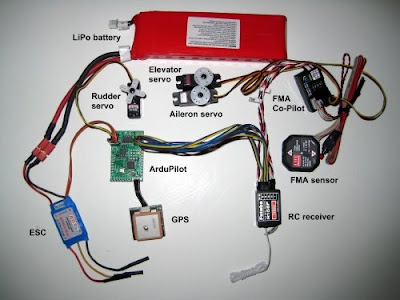
ArduPilot is a full-featured autopilot based on the Arduino open-source hardware platform. It is a custom PCB with an embedded processor (ATMega168) combined with circuitry to switch between RC control and autopilot control (that's the multiplexer/failsafe, otherwise known as a "MUX"). This controls navigation (following GPS waypoints) and altitude by controlling the rudder and throttle. These components are all open source. This autopilot is fully programmable and can have any number of GPS waypoints (including altitude) and It uses infrared (thermopile) sensors for stabilization and GPS for navigation.

microcontroller auto pilot project

tag : Arduino project, Auto Pilot Control, Embedded project src

Arduino Autopilot Control

Arduino Autopilot Control Project

ArduPilot is a full-featured autopilot based on the Arduino open-source hardware platform. It is a custom PCB with an embedded processor (ATMega168) combined with circuitry to switch between RC control and autopilot control (that's the multiplexer/failsafe, otherwise known as a "MUX"). This controls navigation (following GPS waypoints) and altitude by controlling the rudder and throttle. These components are all open source. This autopilot is fully programmable and can have any number of GPS waypoints (including altitude) and It uses infrared (thermopile) sensors for stabilization and GPS for navigation.

microcontroller auto pilot project

tag : Arduino project, Auto Pilot Control, Embedded project src

Tuesday, April 14, 2009

SPOT : AVR Wireless Flash Trigger

wireless flash triger for camera

The SPOT (strobist-project-opensource-trigger)is a remote flash trigger radio transceiver. It lets you adjust and trigger off-camera flashes remotely. It has two modes of operation: First, As a transmitter it sits on the hot shoe of a camera and forwards electrical flash trigger signals from the camera to slave flashes via radio. Secondly, As a receiver it is connected to a small hot shoe ("system") flash. The project use microcontroller AVR ATmega 8L as main controller.

Download :
Documentation and source

tag : microcontroller project, avr ATmega 8L, wireless flash triger


SPOT : AVR Wireless Flash Trigger

wireless flash triger for camera

The SPOT (strobist-project-opensource-trigger)is a remote flash trigger radio transceiver. It lets you adjust and trigger off-camera flashes remotely. It has two modes of operation: First, As a transmitter it sits on the hot shoe of a camera and forwards electrical flash trigger signals from the camera to slave flashes via radio. Secondly, As a receiver it is connected to a small hot shoe ("system") flash. The project use microcontroller AVR ATmega 8L as main controller.

Download :
Documentation and source

tag : microcontroller project, avr ATmega 8L, wireless flash triger


Bart Interrupted: Part Four


We live in a text bound age full of litigious people concerned about copyright, intellectual property, and authorship in the modern sense. I have a friend in fact who is in fact a intellectual property lawyer. You don’t want to know all the permutations and combinations of that law. By contrast, the first century world of the NT writers was a dramatically different world. For one thing, it was largely a world of oral cultures. Perhaps 10-15% of the populus was literate, could read and write, and even less actually owned ‘texts’ or manuscripts. Furthermore, the production of texts in antiquity was a tremendously laborious process, and expensive as well. Scribes did not come cheap, papyrus and ink was not cheap, and the codex, or notebook form compilation was just coming into existence in the first century A.D. Most documents were written on a single sheet of papyrus which would be rolled up and tagged, with what I like to call a toe tag—a small identifying marker. Scribes were not mere secretaries in antiquity, they were in fact the intellectuals and scholars of their age. It you want to learn about their various roles you can read several of the chapters in my forthcoming Baylor book What’s in a Word.

Not surprisingly, ancient views about ‘authorship’ are not quite the same as modern views which assume ‘individual’ authors for almost all documents that aren’t collections of essays by some group of scholars. However in ancient collectivistic cultures this was not the norm. Many, if not most ancient documents were anthological in character--- a compilation of traditions from various different persons and ages through time. This was true about collections of laws, proverbs, songs, religious rituals, and stories as well. We should not be surprised in the least in reading through the book of Proverbs that all of a sudden in a book ascribed to Solomon, we have in Prov. 30 the sayings of Agur, or in Prov. 31 the sayings of King Lemuel, whoever he may have been. Or again, the psalms are compilations from various different ages, some are probably songs of David, but some are songs for or dedicated to David, some are composed by others still. It is a mistake to evaluate ancient documents as if they were just like modern documents, and this applies to NT documents as well, in various regards.

For example, the vast majority of scholars are in agreement that the Gospels we call Matthew and Luke are compilations from a variety of sources, including Mark and a sayings collection, and some unique material not found in other Gospels. Of course, this becomes puzzling to modern readers of Matthew because they rightly ask the question--- why would an eyewitness apostle like Matthew need to use secondary sources for events he was present to view? Why indeed. Here is where I say to you that while we must properly answer this question, one also needs to not do what Bart Ehrman does in his chapter on who wrote the Bible when it comes to this issue—which is to suggest that these Gospels were originally anonymous, and labels were added to them later for apologetical purposes, and that when we read of who they are attributed to in an early source like Papias, we can with a wave of the hand simply dismiss such evidence. If you want to read what a historian of merit has to say indetail about the Papias’ traditions I would point you to Richard Bauckham’s book Jesus and the Eyewitnesses, which is mostly a close reading and explanation of Papias and what he says. It does not in any way agree with Ehrman’s analysis of these early traditions. Indeed, most scholars today think there was a collection of the four canonical Gospels together at some point early in the second century in codex form which is when we get the official labels—according to Matthew etc. based on earlier traditions about the sources of these documents (see e,g, the work of Graham Stanton).

When the Gospel documents were originally written, the audiences that received them knew who the authors were and had a relationship with them. This is especially clear from a text like John 21 which informs us that while the final compiler of the Fourth Gospel is not the Beloved Disciple, nevertheless, he is the source of the traditions in this Gospel, having written them down, and “we know that his testimony is true”. The compiler of the Fourth Gospel knows the man personally, and can vouch for his trustworthiness in telling the Gospel stories. So let’s deal now with some of the flimsy assumptions made which are the basis of Ehrman’s conclusions.

1) Assumption One: The canonical Gospels were probably originally anonymous. This is wrong on two counts. First, when these documents were written down, if there were not identifiers in the document, the papyrus would have been tagged by the scribe to be able to distinguish it from other documents, and these tags regularly had the names of the author or compiler and sometimes a short title as well or instead. Second, we should not imagine that the Gospels were written for general public consumption. Publishing in antiquity was almost always an in house, small audience thing, unless we are talking about Emperor’s publishing laws and propaganda. The circles for which these Gospels were written in all likelihood knew who wrote these documents. Papias is simply basing on to us the early traditions about Matthew, Mark, and John that he heard personally from John the elder, who had know various of the eyewitnesses.

2) Assumption Two: In the case of a Gospel like Matthew which includes some 95% of Mark within it, obviously this means that Matthew had nothing to do with the content of this Gospel since it relies on earlier and even secondary sources. This sort of reasoning ignores the anthological nature of most ancient documents. All it took for a document like Matthew to be labeled ‘Matthew’ is if he was the most famous source used in the document for some of its material. And of course if the three sources used in that document are: 1) material from Mark, not an eyewitness, 2) material from Q or a sayings collection; 3) material from some other unique source scholars usually call special M material, then if either 2) or 3) came from Matthew, his name would take precedent over Mark’s in the document, especially if there very first source material in this Gospel, the birth narratives, came from Matthew. What Papias says is that Matthew had compiled some of the largely sayings material of Jesus in Aramaic or Hebrew. This sounds more like 2) above, than 3), but Papias is general enough that it could be 3) since the Greek word logia need not mean just ‘sayings’. It could mean teachings, for example or even ‘words about the Lord’.

3) Assumption Three: Jesus’ disciples were “lower-class, illiterate, Aramaic speaking peasants from Galilee.” (p. 106). First of all fisherman are not peasants. They often made a good living from the sea of Galilee, as can be seen from the famous and large fisherman’s house excavated in Bethsaida. Secondly, fishermen were businessmen and they had to either have a scribe or be able to read and write a bit to deal with tax collectors, toll collectors, and other business persons. Thirdly, if indeed Jesus had a Matthew/ Levi and others who were tax collectors as disciples, they were indeed literate, and again were not peasants. As the story of Zaccheus makes perfectly clear, they could indeed have considerable wealth, sometimes from bilking people out of their money. In other words, it is a caricature to suggest that all Jesus’ disciples were illiterate peasants. And Bart is absolutely wrong that Acts 4.13 says otherwise--- what Acts 4.13 says is that the council is shocked at the theological capacity of Peter and John because they are ‘unlettered’. This is not the ancient word for illiterate, it is the word for not being learned, not having done formal school training, say in a synagogue.

We need to move on now and consider what Bart says about forgeries and intellectual property in antiquity, and yes indeed there was a concern about such matters in the first century A.D. though certainly not to the same degree as we find today. Bart is also right that there were also not only forgeries in antiquity, there were also pseudepigrapha of various sorts. Now the latter has to be evaluated on a genre by genre basis. By this I mean that while there was a literary convention when it came to apocalyptic works to ascribe those works to ancient luminaries or worthies (e.g. the Testament of Abraham is not by Abraham, the Parables of Enoch are not written by Enoch and so on), it was not an approved literary practice to write letters in the name of other persons without their approval or dictation. This issue has to be evaluated according to the literary type of document we are talking about. The parables of Enoch are not a forgery, they are a pseudepigraphic apocalyptic document and the conventions were well known in early Judaism about such documents.

Pseudonymous letters, sermons or speeches are a whole different ballgame. These, if they are genuine letters or sermons, can be called forgeries if there is no connection between the putative author and the actual author of a given document. Bart is absolutely right when he says “Ancient sources took forgery seriously. They almost universally condemn it, often in strong terms.” (p. 115). He is also quite right that forgeries had the intent to deceive. And he is also equally right that various of these sorts of documents were penned in the second century A.D. to add to the corpus of Christian writings for various purpose. A good example of this would be the so-called Acts of Paul and Thecla, or the Epistle to the Laodiceans. Our concern is not however with such documents, but with those from the first century A.D. (and it is only first century documents in the NT) that made it into the canon of the New Testament. Are their forgeries in the NT?

First of all, we need to bear in mind that anonymous documents are not pseudonymous documents. Hebrews for example, has no attribution of authorship internally or externally, it is an anonymous sermon. Perhaps Apollos wrote it, but in any case, the author of the document is not trying to pass it off as written by some luminary. Secondly, there are documents which are internally anonymous but had an external attribution. For example 1 John, in the content of the document says nothing about the author at all. It is a sermon, and it appears that early Christian sermons, like Hebrews, were frequently produced without internal attribution. And exception to this is James. Bart wants to argue that this is by some otherwise unknown James. The problem with this suggestion is shown by the many commentators on the book of James, and also by the content of the book, which draws on no less than 20 sayings of James’ brother Jesus. As Bauckham has shown at length, there is no reason to doubt James is by the famous James the brother of Jesus, any more than there is reason to doubt Jude, who identifies himself as James brother is by Jude, the brother of Jesus. On the other hand, Bart is right that Revelation is by one John of Patmos, who is probably not John Zebedee, nor is he the Beloved Disciple. This man was a apocalyptic prophet whose Greek and theologizing is different from that found in the other Johannine documents (see my Revelation commentary).

The real issue when it comes to pseudeigrapha in the canon is whether documents like 2 Thessalonians, Colossians, Ephesians, the Pastoral Epistles, 2 Peter are pseudepigrapha. Bart thinks they are, and I think they are not. For the record, the commentators are about evenly divided on most of these books with the exception of 2 Peter, which most take to be a pseudepigrapha. In fact 2 Peter is a compilation document which draws on Jude in its second chapter, and on a testimony of Peter in the first chapter, and perhaps some Pauline material as well in 2 Pet. 3. As a compilation document it is attributed to its first and most famous source Peter. There is a Petrine testimony about the Transfiguration in 2 Pet. 1, that likely goes back to Peter himself. The compiler of the document does not see or present himself as an author. He follows the ancient tradition of attributing the compilation to its most famous contributor, as we saw was true for Proverbs, Psalms, Matthew as well.

But what about those Pauline letters? Let me remind the readers that Paul certainly used scribes. We see this in various of the ways Paul ends documents. For example, in Gal. 6 he says he is now taking up the pen and writing a bit in his own hand, which clearly implies he has been using a scribe to compose the letter. Or in Rom. 16 we have a greeting from the scribe Tertius whom Paul used for that document. In the Pastoral Epistles Paul tells us “Luke alone is with me” which explains why the Pastorals reflect so much Lukan vocabulary and style. ‘Authorship’ in the ancient world was a term that basically meant ‘a document which comes from the mind of X and faithfully reflects his views/message, whoever actually composed the document’. If an author had a faithful scribe who knew his mind on an issue, he could simply tell the scribe—compose a document on X on wax, I will review it, then you may copy it out on a papyrus, with possible changes. There was a sliding scale between on the one end using a new or hired scribe to simply take dictation for most of the document and on the other end of the spectrum using a trusted colleague who knew one’s mind to compose a document. Paul and Peter (using Silas, see 1 Pet. 1) used such scribes to convey their thoughts for them. When one examines these NT letters carefully, and takes into account the ancient conventions about composing such letters, I see no reason to conclude any of these documents are forgeries, particularly on the basis of style, which is a function of personality and personal preference if one is a skillful writer, and it depends on the type of letter one is writing as well. Rhetorical style was chosen according to the situation. Furthermore, a skillful scribe could choose to write in verbose Asiatic Greek rather than Attic Greek if he chose (cf. e.g formal English English to American slang). When we take these things into consideration, as we should there is no reason to come to the conclusions Bart does about forgeries in the NT.

The early church, as we begin to see already in Papias, was confident that their ultimate source documents went back to apostles, prophets, eyewitnesses and their co-workers, which is why these 27 documents are in the NT. They were composed by Paul (with help of scribes and co-workers), Peter (1 Peter with help of Silas probably), Mark, Luke (both co-workers of both Peter and Paul), the 4th Evangelist (drawing on Beloved Disciple written sources. The Beloved Disciple composed 1-3 John himself), the compiler of Matthew, James, Jude, perhaps Apollos in the case of Hebrews, John of Patmos, and at the very end of the NT period, the compiler of 2 Peter, drawing on Petrine and other materials.

In short, the NT can be traced back to about 8 people, either eyewitness apostles, or co-workers of such eyewitnesses and apostles. Early Christianity's leaders were largely literate, and some of them, like Paul and the author of Hebrews, were first rate rhetoricians as well (see my little primer NT Rhetoric).

Friday, April 10, 2009

Let's Discuss (Senior Projects/Everythings) in our Forums

Working on Microcontrollers is needed some practical experiences. Due to this reason, I started the Microcontroller Programming Forums for community discussion. The aim is to create an online discussion board there the members can helps each other. Sharing an experience is expectation for our Forums. Whoever you are i.e. Engineer, Scientist, Student, Hobbyist, alls are welcome to our forum:

http://mcuprogramming.com

For a student who is working on senior project related to MCUs, it is a great chance to find an expert you can consult online.

Why don't you joint us. Please become our member.